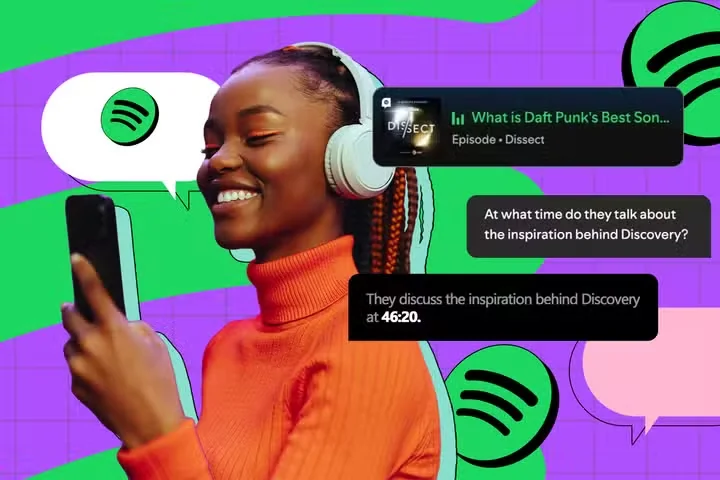
Podcasts have a structural problem that every listener knows and no platform solved: life interrupts episodes that were designed to be continuous. A thirty-minute commute ends, a meeting starts, a toddler appears, and the player pauses at an arbitrary point inside someone else's unbroken monologue. Resuming later means either losing the thread or rewinding through minutes of context to recover it. Spotify believes artificial intelligence has finally made that problem optional.
The feature at the center of this change is an AI-generated episode summary that appears before playback begins. Instead of committing blind to an hour of audio, listeners scan a compressed preview of what the episode actually covers, decide which segments matter, and jump directly to the part worth their remaining attention. The pause button, in turn, stops being a bookmark of desperation and becomes a deliberate choice.
The practical effect on listening habits has been surprisingly large. Long-form interviews that previously accumulated abandoned progress now get finished in targeted sittings. Shows with uneven pacing are tolerated because the summary tells the listener whether the payoff justifies the setup. Even the decision to start an episode becomes cheaper, which quietly benefits the creators who struggled to convert curious clicks into committed listening hours.
Not everyone celebrates the change. Purists argue that summaries flatten the art of conversational storytelling and encourage a skimming culture. But for the majority of listeners whose attention is genuinely fragmented, the value proposition is obvious. The worst thing about long episodes was never their length — it was the uncertainty of whether they deserved it. Spotify has removed the uncertainty, and the pause button has never seen less action.